
Read-only access to SAP
DataVolumeIQ does not insert, update or delete SAP data, change SAP configuration, or execute archiving, housekeeping or optimization jobs in SAP.
Designed for use with SAP® software, DataVolumeIQ gives platform, Basis, DVM and governance teams a unified view of data growth, evidence-driven SAP HANA® memory reduction, archiving and ILM readiness, automated recommendations, SAP S/4HANA® & RISE with SAP® transformation impact and measurable value realization.
Read-only SAP analysis · Approved technical metadata · No changes to SAP systems or data
Business outcomes
See where growth is coming from by system, module, table, age and business context.
Prioritize memory, disk, housekeeping and archiving opportunities before adding capacity.
Bring retention, residency, legal holds and destruction readiness into one evidence-led workflow.
Model footprint reduction, migration scenarios and historical-data strategies before transformation.
Read-only SAP analysis
DataVolumeIQ provides analysis and recommendations from approved technical metadata. It makes no changes to your SAP systems or the data they hold. Any implementation is performed separately by your authorized SAP team through your change-control process.
DataVolumeIQ does not insert, update or delete SAP data, change SAP configuration, or execute archiving, housekeeping or optimization jobs in SAP.
Analyze table and archive sizes, record counts, aggregated data-date ranges, last observed read or access activity where available, growth rates, and memory or disk utilization.
Business-document contents, transaction-level business values, SAP user information and personally identifiable information (PII) are outside the intended SAP analysis scope and must be excluded from approved extracts.
Customer-approved, least-privilege collectors and extracts define the collection scope. Review custom uploads, free-text logs and SQL diagnostics at source to remove business values, identifiers and personal information before sharing. DataVolumeIQ does not guarantee that an arbitrary uploaded file is free of sensitive content.
Portal account details, contact information supplied in a demo request, and administrator-entered ownership or approval information are separate from SAP technical metadata and are handled for the relevant service purpose.
Why DataVolumeIQ
SAP teams already have operational tools for database administration, archiving and lifecycle management. DataVolumeIQ adds the intelligence layer that connects those domains, explains priorities and helps teams govern outcomes.
Correlate technical SAP volume, SAP HANA® consumption, archiving context, ILM controls, security posture and financial impact in one decision layer.
Trace recommendations back to systems, tables, SAP HANA® diagnostics, archiving objects, policies, rule IDs, evidence classes, confidence and source datasets instead of relying on opaque scores.
Connect analysis to approvals, evidence, exceptions, verification and audit history while keeping production execution in customer-approved SAP operational procedures and tools.
Move beyond theoretical savings by linking reduction opportunities to tracked actions and finance-ready value evidence.
Platform
DataVolumeIQ brings SAP DVM, SAP HANA® optimization, archiving, ILM, system applicability, scenario planning and value realization into one role-based enterprise platform.
Collect, review and approve evidence, then verify database reduction, reclaimed capacity and finance-accepted value in sequence.
Keep modeled opportunities, measured database reduction, reclaimed capacity and finance-accepted value separate.
Give executives high-level dashboards and scenarios, functional owners their assigned areas, and administrators tenant configuration controls.
Analyze database size, monthly growth, modules, tables, data age and reduction potential across the SAP landscape.
Correlate column memory, compression, delta, NSE, unloads, heap, SQL peak memory, LOB, partitioning and reclaim evidence through the Memory Reduction Cockpit.
Prioritize archiving objects, validated eligibility, execution readiness and technical housekeeping, with ECC/S/4 installed-object inventory and dependency context.
Bring retention, residency, legal holds, policy evidence and destruction readiness into a governed lifecycle.
Connect systems, modules, tables, archiving objects, policies, risks and actions into explainable insight chains.
Model archive, aging, compression, retention and transformation scenarios before making production decisions.
Automatically populate recommendations from uploaded SAP evidence, collapse duplicates, expose confidence/provenance and turn findings into governed actions.
Use ABAP-based installed component inventory and applied SAP Notes to assess applicability, track remediation and document exceptions.
Ask contextual questions, summarize findings and accelerate analysis using the evidence already available in the platform.
What the platform measures
DataVolumeIQ focuses on decision-relevant measures rather than vanity metrics. Customer values are calculated from the evidence loaded for each tenant.
A focused DataVolumeIQ service for SAP HANA® teams that need to understand where memory is consumed, which technical reduction levers are supported by actual evidence, and what should be reviewed next.
The cockpit correlates SAP HANA® memory, column, NSE, unload, heap, SQL, LOB, partition and reclaim datasets without mixing working memory, transient counters or modeled opportunity into realized savings.
Main, delta, page-loadable memory, compression evidence and column-level contributors.
PAGE/COLUMN recommendations, confidence and physical footprint with governed review thresholds.
Unload events, heap consumers, reclaim activity and service-memory context.
Peak statement-memory evidence kept separate from persistent table footprint.
Compression, delta merge, LOB and partition reviews generated from uploaded evidence.
Modeled relief, candidate footprint and measured outcomes remain clearly separated.
SAP HANA® native storage extension
SAP HANA® native storage extension (NSE) is designed for warm, less-frequently accessed data that does not need to stay fully loaded in memory. DataVolumeIQ brings NSE Advisor evidence into Cold Data & Usage Analysis so teams can review SAP recommendations alongside read, write, unload and access context.
Total workload-based NSE Advisor recommendations available for review.
Objects SAP HANA® recommends evaluating for page-loadable warm-data placement.
Objects recommended to remain column-loadable for workload performance.
Recommendations with stronger advisor confidence, helping teams prioritize review.
Physical footprint associated with PAGE recommendations — shown as footprint, not assumed savings.
Visibility into recommendations already configured as page-loadable where current load-unit evidence is available.
Evidence acquisition
DataVolumeIQ consolidates technical collection into recommended extraction packs instead of forcing customers to manage a separate SQL or ABAP extract for every dashboard.
Recommendation intelligence
DataVolumeIQ automatically turns uploaded SAP evidence into an execution queue while preserving the distinction between measured facts, SAP advisor output, DataVolumeIQ review guardrails and validated business eligibility.
Uploaded datasets are evaluated immediately against the active recommendation rules.
Every recommendation can expose rule ID, source feeds, evidence class and confidence.
Age and DB15 mapping are never treated as archiving eligibility without validated evidence.
Residence, retention, legal holds and missing evidence remain explicit blockers or review actions.
Evidence & lifecycle
Estimated opportunity, approved scope, measured reduction, reclaimed capacity and finance-accepted savings remain separate. Each result carries its supporting evidence.
Upload scoped extracts and establish the system, table and cost baseline.
Validate source quality, residence, retention, legal holds and business prerequisites.
Record business, compliance and technical approvals with evidence.
Compare before/after snapshots and record the execution result.
Confirm usable memory or disk capacity separately from logical deletion.
Record Finance acceptance and supporting cost or invoice evidence.
High-level outcomes, forecasts and scenario planning.
System health, SAP HANA®/NSE analysis and technical remediation.
Assigned functional modules and business review.
Policy evidence, legal holds and authorized review or read-only access.
Team, data-source and tenant administration.
Menus, submenus and actions follow subscription entitlements, assigned role, tenant authorization and functional module scope.
Workspaces are organized around SAP DVM decisions — from executive visibility, Data Age and SAP HANA® memory analysis through archiving-object dependencies, ILM, system applicability, automated recommendations, execution and value realization.
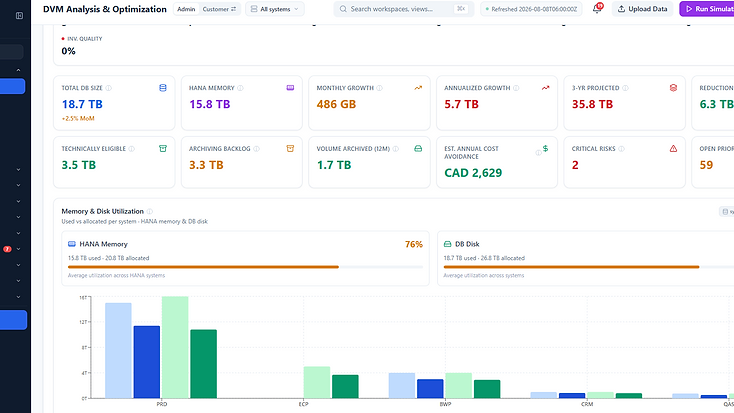
Bring database growth, SAP HANA® utilization, reduction potential, archiving backlog, risk and action context into an executive view.
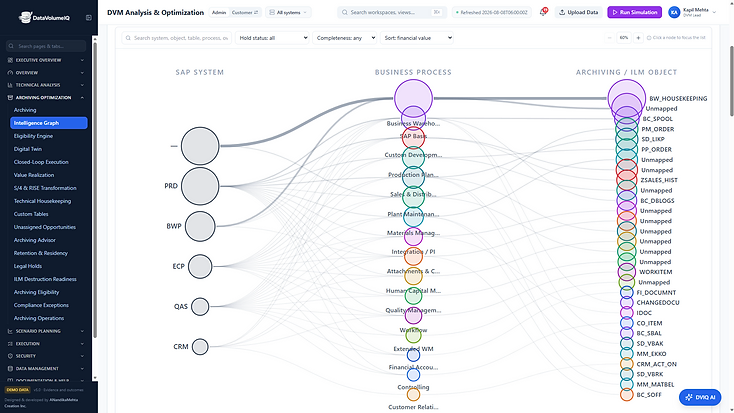
Move from system and table evidence to validated archiving candidates, SAP HANA® memory-reduction opportunities, dependency-aware archiving context and explainable prioritized actions.
Illustrative product previews with demo data. Available workspaces and controls depend on subscription, purchased services and customer authorization.
SAP S/4HANA® & RISE with SAP®
Use DataVolumeIQ to bring footprint reduction, retention, archive continuity and capacity scenarios into transformation planning before sizing and migration decisions are finalized.
Model how archiving, housekeeping and data-age strategies can reduce the source footprint before SAP S/4HANA® or RISE with SAP® sizing decisions.
Plan how archived and legacy information remains governed and accessible after transformation without carrying unnecessary transactional volume forward.
Bring retention, residency, legal holds and destruction readiness into migration planning rather than addressing them after cutover.
Evaluate baseline and optimized scenarios for capacity, growth, operational risk and expected value before committing to a target architecture.
SAP architecture
DataVolumeIQ reads approved technical SAP metadata, archiving context, SAP HANA® utilization and ILM controls, and analyzes security posture and financial impact without modifying SAP systems or data.
ECC · SAP S/4HANA® · BW · SAP HANA®
Approved technical metadata through read-only extracts or read-only SAP connectivity
DVM · Archiving · SAP HANA® · ILM · Security · Scenario modelling
Recommendations · Approvals · Evidence · Value realization
DVIQ AI Copilot
DVIQ AI accelerates analysis and communication using available DataVolumeIQ evidence. Customer permissions and subscription quotas apply. Review AI conclusions and approve execution through your SAP operating procedures.
Query the evidence available within your tenant, system and functional permissions. Keep source references and missing evidence visible.
Investigate growth drivers, compare planning scenarios and draft next actions with evidence and assumptions.
Turn technical findings into concise leadership-ready narratives while keeping source context visible.
How it works
Analyze SAP database growth, SAP HANA® usage, data age, tables, modules, archiving backlog and technical risk.
Prioritize archiving, housekeeping and SAP HANA® reduction opportunities with scenario modelling and savings estimates.
Apply retention controls, approvals, action tracking and value realization with evidence and auditability.
Enterprise Security & Trust
Security, identity, auditability, retention and customer offboarding are treated as platform capabilities, not afterthoughts. Enterprise buyers can review the public security overview and request the current procurement package.
SSO / SAML / OIDC support by plan, with MFA-ready identity controls.
Role-specific workspaces and permissions for executive, Basis, DVM, functional, compliance and audit users.
Evidence, action history, approvals and exportable audit context for governed decision-making.
Customer data and access are designed around tenant-scoped authorization and least-privilege controls.
Retention, deletion, backup and offboarding controls are surfaced through enterprise trust workflows.
SAP Patch Day, applicability, remediation, exceptions and operational security insights in the same platform.
Plans & consultation
Book a personalized demo to explore the platform and receive pricing for your systems, services and implementation needs.
A focused DVM program for one SAP system.
An active optimization program across two systems.
Governance and planning across four SAP systems.
One system means one SAP SID. DEV, QAS and PRD each count separately; clients within a SID do not use another slot. Additional systems are available on Enterprise, up to 7 total. Managed storage holds uploaded extracts and evidence. Portal retention does not define retention of SAP archive documents.
Discuss additional capacity and capabilities during your demo. Platform ceilings remain 7 systems, 150 users and 800 GB.
We will review your SAP landscape and explain subscription options, one-time setup, add-ons and specialist services during your demo.
Book a demo to discuss pricingExample outcomes
These are the types of outcomes DataVolumeIQ is designed to support. Customer-specific results depend on landscape size, data quality, retention policy, operating model and execution.
Identify memory and disk reduction opportunities before infrastructure expansion or cloud resizing decisions.
Prioritize archiving and housekeeping using data age, growth, technical evidence and business context.
Model migration footprint and historical-data strategies before transformation planning is locked.
Connect retention, legal holds, destruction readiness, actions and evidence into a repeatable operating model.
FAQ
See how DataVolumeIQ can help your SAP platform team identify reduction opportunities, govern archiving and ILM, improve SAP HANA® efficiency and prepare for SAP S/4HANA® or RISE with SAP®.

